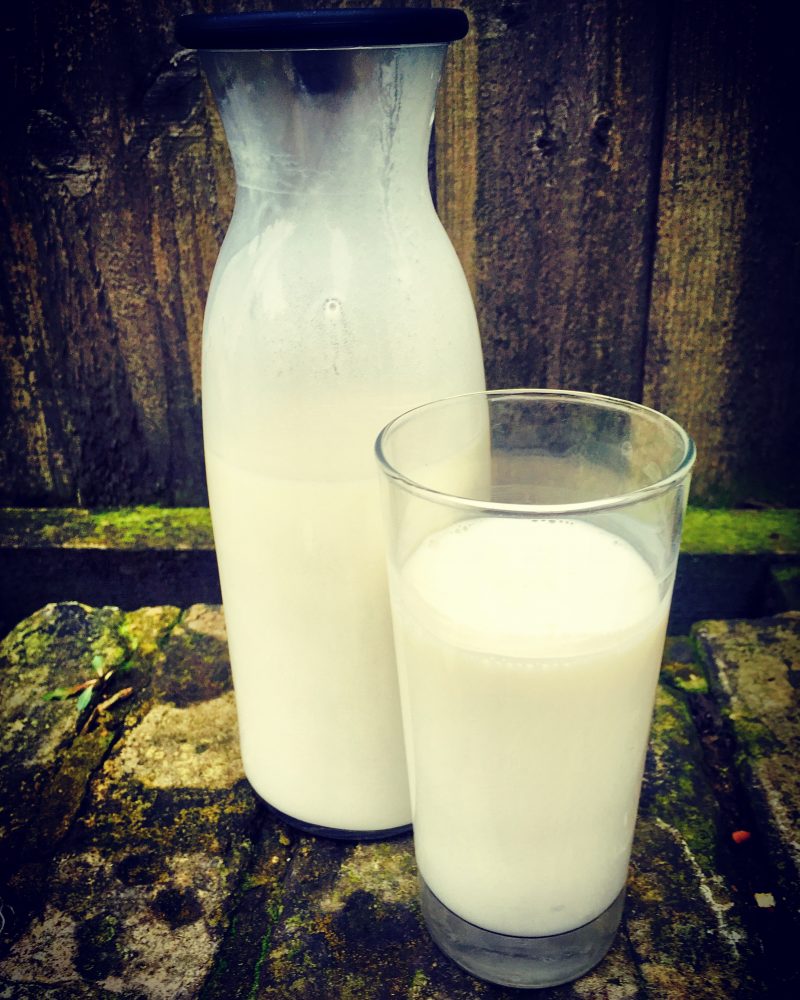
Fermenting raw milk lowers some germs but doesn’t reliably remove them, so heat raw milk before you culture it. For yogurt the
usual heating step does the job, provided all the milk reaches 82–85°C (180–185°F): stir it, check it with a thermometer, and never skip that step with raw
milk. Kefir, buttermilk, crème fraîche and other cultured
milks made at room temperature have no heating step, so pasteurize raw milk first, cool it, and then add the grains or starter.
What FDA and CDC Say About Raw Milk
Raw milk can carry Campylobacter, Cryptosporidium, E. coli, Listeria, Brucella and
Salmonella, and CDC names “drinking or eating products made from raw milk” as a route to them. Good farm practice reduces
contamination but “cannot guarantee safety” (CDC). Children under 5, adults over 65, pregnant women and people with
weakened immune systems are the most likely to become seriously ill (same source).
A common reason for choosing raw milk is that its bacteria are thought to be probiotic. FDA’s answer is no: the bacteria in raw
milk come from the udder, the farm environment and milking equipment, and they “are not probiotic”. Pasteurization kills raw milk’s
pathogens “without any significant impact on milk nutritional quality” (FDA). The microbes that make kefir and yogurt
are the ones you add, in the grains or the starter.
What Researchers Found When Germs Met Fermentation
Several studies put pathogens into milk, fermented it, and counted what was left. The results differ because the conditions did:
how much fermentation removes depends on the culture, the temperature, how sour the milk ends up and how long it’s kept.
| Study | What was tested | What happened |
|---|---|---|
| Agroscope and BFH-HAFL, Switzerland (2023) | Yogurt from 10 raw milks, each made mild (pH 4.4–4.5) and sour (pH 3.9–4.0); a second test with bacteria added on purpose |
E. coli and S. aureus were detectable in fresh mild yogurt, not after 14 days; neither in the sour yogurt. Genes of Shiga-toxin E. coli turned up in one fresh mild and one 14-day sour yogurt, though no live bacteria could be isolated. With bacteria added on purpose, counts fell about a million-fold in sour yogurt but only 10- to 100-fold in mild (full article, in German). The authors call sour raw-milk yogurt at pH 4.0 or below safe, but only from high-quality raw milk. |
| Ogwaro et al. (2002) | E. coli O157:H7 (a strain that makes no toxin) in pasteurized milk fermented with yogurt cultures for 24 hours at 25–43°C |
At 25–37°C it multiplied from 105 to 108–109 per ml, a thousand-fold rise or more. Only at 43°C did it decline. |
| Dineen et al. (1998) | E. coli O157:H7 added to finished shop products | Recovered for up to 12 days in yogurt (pH 4.0), 28 days in sour cream and still present at 35 days in buttermilk. |
| Schaack and Marth (1988) | Listeria monocytogenes in cultured skim milks and yogurt, kept at 4°C |
It survived yogurt making, and lasted from a few days to 37 weeks in the fridge depending on the culture. |
| Dlamini and Buys (2009) | E. coli O157:H7 in goat-milk amasi at about 30°C | Still counted after 3 days in commercial-style amasi (24 hours at 30°C, then chilled); not detected after the traditional 3-day ferment. |
| Macuamule et al. (2016) | A vaccine strain of the bovine tuberculosis bacterium in milk fermented with kefir grains |
Down about a hundred-fold after 48 hours and undetectable after 60 hours. The authors still advise boiling or pasteurizing the milk. |
| Harrell et al. (2026) | Avian influenza virus in raw-milk yogurt, about 7 hours at 42°C | At least a ten-thousand-fold drop, also in raw milk held at 42°C with no culture. |
| Porto-Fett et al. (2026) | Two low-pathogenic avian influenza strains in raw milk fermented with a commercial kefir starter, about 36 hours at 25°C |
Down roughly a thousand- to ten-thousand-fold; about as much in raw milk left at 25°C with no starter. |
Most are lab experiments in which germs were added on purpose, some to pasteurized milk or shop products instead of raw milk;
the Swiss study also tested what ten raw milks brought with them. None of them followed people who ate the products. They show what
can happen, not how often a given jar would make someone ill. Very sour isn’t a guarantee either: in Dineen’s study E. coli
O157:H7 was recovered for 12 days from yogurt at pH 4.0, and in Schaack and Marth’s Listeria survived up to 12 days in
yogurt at pH 3.93.
Why Yogurt and Kefir Aren’t the Same Case
Yogurt is fermented hot and fast. Standard yogurt making heats the milk to 82°C for 30 minutes before the culture goes in, and that
step alone inactivates avian influenza virus. The researchers note that some home recipes leave it out (Harrell et al., 2026).
The culture then works at about 42°C for a few hours. Our yogurt method heats the milk to 82–85°C first,
which is well above the home pasteurization point of 72°C for 15 seconds (Ohio State University Extension), as long
as you stir and hold it there a few minutes.
Kefir, amasi, buttermilk, crème fraîche and filmjölk-type milks are cultured at room temperature for a day or more, with no heating
step. That’s the range in which E. coli O157:H7 multiplied a thousand-fold or more in the 2002 study (pasteurized milk
with yogurt cultures; at 25°C it had only reached pH 5.0 after 24 hours), and it was still there in large numbers after five days
in the fridge (Ogwaro et al., 2002). How sour and how long also matter: in the amasi study, E. coli O157:H7
outlasted a short ferment that was then chilled, but not a three-day traditional one (Dlamini and Buys, 2009). Once
the product is finished, the cold doesn’t finish the job either: Listeria survived for weeks in refrigerated cultured milks
(Schaack and Marth, 1988).
Souring can cut some germs well below what the raw milk carried, as in the TB vaccine-strain study. But E. coli O157:H7
can multiply during a slow ferment, and a home kitchen can’t measure which germs the milk started with, so a sour taste doesn’t tell
you the jar is safe.
How to Heat Raw Milk Before You Culture It
Ohio State University Extension’s stovetop method (HYG-5817):
- Pour the milk into the top of a double boiler, with water in the bottom. Keep an accurate metal-stem thermometer and a spoon in
the milk the whole time. - Heat to 161°F (72°C), stirring constantly so all the milk gets there, and hold it there for at least 15 seconds.
- Cool it fast. Set the pan in cold water and keep stirring; below 130°F (54°C), switch to ice water until the milk reaches 40°F
(4°C) or below. - Store it in the fridge at 40°F (4°C) or colder until you use it.
Ohio State’s slower alternative heats the milk in jars in a canner, loosely covered, to 145°F (63°C) for at least 30 minutes, with
every part of the milk including the foam at that temperature; if it drops below 145°F, the 30 minutes start again. Ohio State calls
the double boiler the most common method. Ohio State doesn’t recommend a microwave: it heats unevenly.
Pasteurizing doesn’t rescue milk that’s already been mishandled: start with clean milk from healthy animals, kept cold, and use
clean equipment after heating. The simplest choice is still pasteurized milk from a shop.
For yogurt, follow the recipe’s 82–85°C step. For milk kefir or the
cultured buttermilk, sour cream and crème fraîche recipes, cool the heated milk quickly as in step 3, stopping at
room temperature (about 20–25°C) if you’re adding the grains or culture straight away, or chilling it to 4°C if you’re not. Kefir
grains don’t need raw milk: they ferment pasteurized milk normally.
Traditional Raw-Milk Ferments
Many fermented milks were, and in places still are, made by leaving raw milk to sour on its own: South African
amasi, Moroccan raib and the Fulani nono among them. Our pages describe
how they’re made traditionally and give a home method with pasteurized milk and a starter. Spontaneous souring also depends on the
milk’s own bacteria, so heated milk needs a starter to sour reliably.