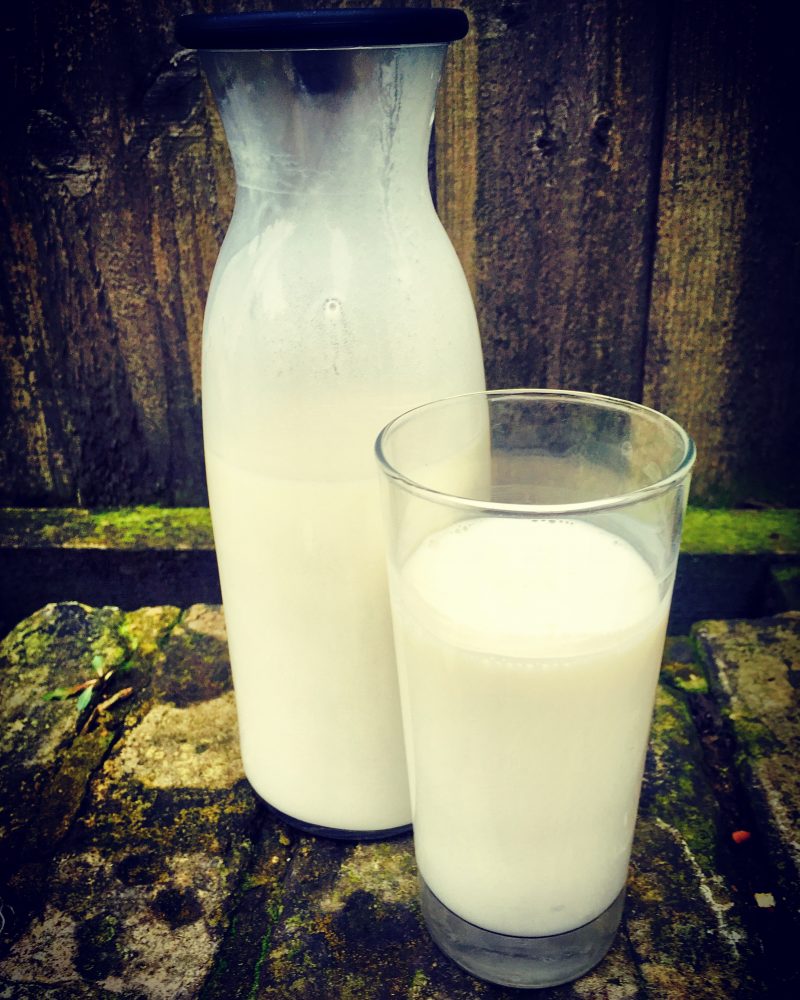
Buttermilk, sour cream, crème fraîche and cultured butter are the same ferment at different fat levels. A “mesophilic” culture,
lactic acid bacteria that work at room temperature, sours milk or cream overnight; what you start with decides what you get.
Unlike yogurt, none of them needs an incubator.
One Culture, Four Products
| Product | Start with | Culture at | Ready when |
|---|---|---|---|
| Cultured buttermilk | Pasteurized milk (whole or lower-fat) | Room temperature, 12–24 h | Thick, pourable, clean and tangy |
| Sour cream | Pasteurized cream, 14–20% fat (light or table cream) | Room temperature, 12–24 h | Set and spoonable |
| Crème fraîche | Pasteurized heavy or whipping cream (36% fat or more) | Room temperature, 12–24 h | Thick, nutty and mildly sour |
| Cultured butter | Crème fraîche-style cultured cream, chilled | Churned cold | Butter grains separate from buttermilk |
The legal definitions say the same thing. In the US, cultured milk is pasteurized before the culture goes in and must reach a titratable
acidity of at least 0.5% as lactic acid (21 CFR 131.112); sour cream is pasteurized cream soured by lactic acid
bacteria, with at least 18% milkfat and the same 0.5% acidity (21 CFR 131.160); heavy cream has at least 36% milkfat
(21 CFR 131.150). Canada’s rule for sour cream is at least 14% milkfat (FOODSAFE BC).
Crème fraîche has no US standard; it’s cultured heavy cream.
The Culture: Where to Get It
- A mesophilic starter (freeze-dried packets sold for buttermilk, sour cream or crème fraîche). Follow the packet’s
amount. This is the most reliable option, and the one British Columbia’s food-safety plans for restaurants require
(FOODSAFE BC, crème fraîche). - Shop-bought cultured buttermilk with live cultures also works as a starter: about 50 ml per litre of milk or cream, the
amount the FAO’s small-scale dairy manual gives for ripening cream for butter (FAO). It works, but the result
depends on how lively that carton’s bacteria are. - Many home cooks re-culture from their last batch. Commercial kitchens under BC’s plans aren’t allowed to
(FOODSAFE BC), because a culture carried on this way can weaken or pick up other microbes. If a batch sets slowly,
tastes off or turns slimy, start again from a fresh culture.
The bacteria are mostly Lactococcus lactis strains, often with Leuconostoc. Some of them turn the citrate in milk
into diacetyl, the compound behind “buttery” flavour (Rincon-Delgadillo et al., 2012). In one study, a sour cream
strain made the most diacetyl at a cool 20°C over 15 hours (Kim et al., 2021): culturing on the cool side of room
temperature gives a more buttery taste. The same family of cultures makes the room-temperature milks of other countries:
Swedish filmjölk, Finnish viili and Moroccan raib.
Method: Buttermilk, Sour Cream or Crème Fraîche
- Choose the milk or cream from the table. Use pasteurized, with no added stabilizers or gums if you can find it:
FOODSAFE BC’s crème fraîche plan says it won’t work with UHT cream or cream with added stabilizers (FOODSAFE BC). - For a thicker body (optional), heat the milk or cream to 82°C for 10 minutes, then cool it to room temperature within
an hour (FOODSAFE BC). - Add the culture to a clean jar (the packet amount, or about 50 ml cultured buttermilk per litre), pour in the milk
or cream and stir gently. - Cover loosely and leave it at room temperature, out of drafts and sun, for 12–24 hours. FOODSAFE BC’s plans allow up
to about 12 hours near 29°C (FOODSAFE BC); the FAO manual ripens cream for 24 hours at 18°C
(FAO). Cooler takes longer. - It’s ready when it has thickened and smells clean and pleasantly sour. If you have pH strips or a meter,
the end point in the food-safety plans is pH 4.6 or lower (FOODSAFE BC). - Chill it straight away; it thickens further in the fridge.
Method: Cultured Butter
- Culture heavy cream as above, then chill it well (overnight is easiest). The FAO manual’s household method uses 50 ml
of buttermilk or starter per litre of cream and 24 hours at 18°C (FAO). - Churn it in a stand mixer, a food processor or a jar you shake. Keep going past whipped cream until the butter breaks out
in grains “as big as peas” and the liquid looks watery (FAO). If nothing happens after about 30 minutes, the cream
is too warm or too cold. - Drain off the buttermilk and keep it: this is the original, “traditional” buttermilk, thinner than cultured
buttermilk, and good for baking. - Wash the butter in cold water, kneading and changing the water until it runs almost clear. “The more buttermilk
you remove, the better your butter”; washing also lowers its water content so it keeps longer (FAO). - Salt it if you like; the FAO manual works in about 10 g of salt per kg of butter (1%) (FAO).
Wrap it and refrigerate.
Butter aged with herbs and salt for months is a different tradition: see North Africa’s smen.
When It Goes Wrong
- If it didn’t thicken, the room was too cold, the culture weak, or the cream UHT or stabilized. Give it a few more hours somewhere warmer.
FOODSAFE BC’s plans discard a batch that hasn’t reached pH 4.6 two hours after its usual time (FOODSAFE BC); at home,
if it hasn’t soured by the next day, throw it out and start with a fresh culture. - Slimy, bitter, yeasty or “off” cream means a contaminated or tired culture. Discard it, wash the jar in hot water and start
fresh. - If mould grows on top, discard the whole jar. In a study of crème fraîche, a mould colony only 8 mm across had produced
ochratoxin A and citrinin in the top 2 cm, at levels above EFSA’s health guidance for a normal serving
(Olsen et al., 2019). Scraping it off isn’t enough. - If the butter won’t come, the cream is too warm (soft, greasy) or too cold (stays whipped). Bring it to cool room
temperature and keep churning.
For how these compare with other fermented milks, see kefir vs yogurt and South Africa’s room-temperature
soured milk, amasi.