Fermented Vegetables & Fruit

How to Ferment Carrots: Easy Probiotic Carrot Pickles in Brine

How to Ferment Carrots: Easy Probiotic Carrot Pickles in Brine

Learn how to ferment carrots with this easy beginner-friendly recipe. Make crunchy probiotic pickles in just 3-7 days. Includes troubleshooting and flavor variations.

At a glance

To ferment carrots, cover sliced or shredded carrots with a 2–3% salt brine – 10–15 g of non-iodized salt per 500 ml of water – keep them submerged under a weight, and leave the jar loosely covered at 65–75°F (18–24°C). Taste from day 4; most batches are tangy in 5–10 days. Then refrigerate.

  • Brine: 10 g salt per 500 ml water (2%) to 15 g (3%). Weigh the salt.
  • Ferment at 65–75°F (18–24°C); taste from day 4, usually ready in 5–10 days.
  • Keep the carrots under the brine – mold grows on anything exposed to air.
  • A flat white film is usually kahm yeast; fuzzy or colored growth means discard.
  • Raw carrots (USDA): 41 kcal, 2.8 g fiber and 8,285 µg beta-carotene per 100 g.

Ferment profile

Fermentation
Lactic acid
Main microbes
Naturally occurring lactic acid bacteria (e.g. Leuconostoc, Lactobacillus)
Live cultures
Yes
Alcohol
None / trace

Recipe: Fermented Carrots in Brine

Makes
1 litre (1 quart) jar
Hands-on
15 min
Fermentation
5–10 days at 65–75°F (18–24°C)
Salt
2–3% brine: 10–15 g salt per 500 ml water
Temperature
65–75°F (18–24°C)
Difficulty
Easy

Equipment

  • 1-litre (1-quart) wide-mouth glass jar
  • Fermentation weight, small jar or brine-filled bag
  • Loose lid, airlock lid, or cloth and rubber band
  • Kitchen scale
  • Plate to catch overflow

Ingredients

  • 450–500 g (about 1 lb) carrots (scrubbed; cut into sticks, coins or shreds)
  • 500 ml (about 2 cups) filtered or dechlorinated water
  • 10–15 g non-iodized salt (2–3% of the water weight)
  • 2–3 garlic cloves (optional)
  • 1 tsp whole spices (peppercorns, mustard, coriander or dill seed) (optional)
  • A few sprigs fresh dill (optional)

Method

  1. Scrub the carrots (peeling is optional) and cut them into even sticks, coins or shreds.
  2. Dissolve the salt completely in the water.
  3. Put any garlic, spices and herbs in the jar, then pack the carrots in tightly, leaving about 1½ inches (4 cm) at the top.
  4. Pour in brine until the carrots are covered by at least 1 inch (2.5 cm).
  5. Add a weight so nothing floats above the brine, then cover loosely so gas can escape.
  6. Leave at 65–75°F (18–24°C), out of direct sunlight, on a plate to catch overflow.
  7. Taste from day 4 with a clean fork. When they're as tangy as you like, close the jar and refrigerate.

Fermented carrots are one of the easiest ferments to start with: carrots, salt, water and a jar. Covered in a 2–3% salt brine and kept at room temperature, they turn tangy and slightly fizzy in about a week while staying crunchy. The recipe below gives the salt by weight, because spoon measurements of salt vary a lot. Further down you’ll find the spiralized ginger-and-turmeric batch we made and photographed in 2016.

How Carrot Fermentation Works

Salt draws juice from the carrots and holds back spoilage organisms, while salt-tolerant lactic acid bacteria that are naturally on the vegetables turn their sugars into lactic acid. As the brine gets more acidic, it becomes cloudy and the carrots turn sour. Keeping everything under the brine matters: bacteria that do the fermenting don’t need air, while the molds you want to avoid do (National Center for Home Food Preservation).

Getting the Salt Right

For a 2% brine, dissolve 10 g of salt in 500 ml of water; for 3%, use 15 g. That’s the range most vegetable ferments use: 2% ferments a little faster and tastes milder, 3% is saltier, slower and a little crunchier. Use non-iodized salt (sea, kosher or pickling salt) and weigh it – a tablespoon of fine salt can weigh twice as much as a tablespoon of flaky salt.

Water 2% brine 3% brine
250 ml (1 cup) 5 g 7.5 g
500 ml (about 2 cups) 10 g 15 g
1 litre (about 4 cups) 20 g 30 g

How Long to Ferment Carrots

  • Days 1–3: little to see at first, then the brine turns cloudy and small bubbles appear.
  • Days 4–7: the carrots become tangy. Start tasting from day 4.
  • After 7–14 days: more sour and slightly softer. Thin or shredded carrots get there faster than sticks.

Move the jar to the fridge when you like the flavor. Cold slows fermentation, and the carrots keep for months as long as they stay under the brine and you use clean utensils.

Flavor Ideas

  • Dill and garlic: fresh dill, 3–4 garlic cloves and a few peppercorns.
  • Ginger and turmeric: slices of fresh ginger and turmeric – or see our fermented ginger carrots.
  • Spicy: sliced jalapeño or a dried chili, onion and cumin seeds.
  • Spiced: cumin, coriander and fennel seeds with a pinch of chili flakes.
  • Our 2016 mix: spiralized carrots with onion, spring onion, garlic, ginger, turmeric, caraway, chili flakes and dried herbs (below).

Troubleshooting

  • White film on top: a flat, smooth film is usually kahm yeast. Skim it off and make sure everything is under the brine. Fuzzy, raised or colored growth (green, black, pink, orange) is mold: throw the batch away (NCHFP).
  • Soft carrots: too warm, too long, too little salt or old carrots. Use fresh, firm carrots, 2–3% brine and 65–75°F (18–24°C).
  • No bubbles: it may be cool or just slow. Taste it: if it’s getting sour, it’s fermenting.
  • Too salty: rinse the carrots before eating, and use 2% next time.
  • Bad smell: sour and pickle-like is normal; rotten or putrid isn’t – discard it.

Carrot Nutrition

Raw carrots provide, per 100 g, 41 kcal, 2.8 g of fiber, 320 mg of potassium and 8,285 µg of beta-carotene (835 µg of vitamin A as RAE), according to USDA (FoodData Central). Fermentation doesn’t turn carrots into a different food – it adds live lactic acid bacteria (if you don’t heat them) and salt, so count the brine toward your sodium.

How to Use Fermented Carrots

  • Straight from the jar as a snack, or on a cheese board.
  • Chopped into salads, grain bowls, slaws, tacos and sandwiches.
  • Blended into dressings, or stirred into hummus.
  • Added to hot dishes at the end, off the heat, if you want to keep the live bacteria.

More: the best vegetables to ferment, fermented vs pickled, India’s black-carrot drink kanji and how to store fermented foods. Another sweet root that ferments well is sweet potato.
From our kitchen

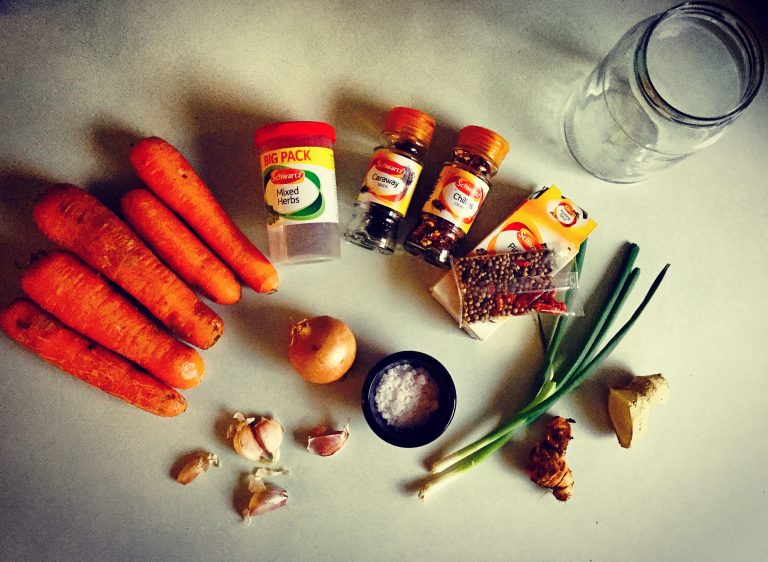
Our original fermented carrot recipe, first published here in 2016, was a spiced, spiralized version rather than plain sticks. We used 5 carrots, a small onion, 2 spring onions, 5 garlic cloves, a thumb each of fresh ginger and turmeric, pickling spices, a tablespoon each of caraway seeds and chili flakes, and 1–2 tablespoons of dried mixed herbs, with 3 tablespoons of salt.

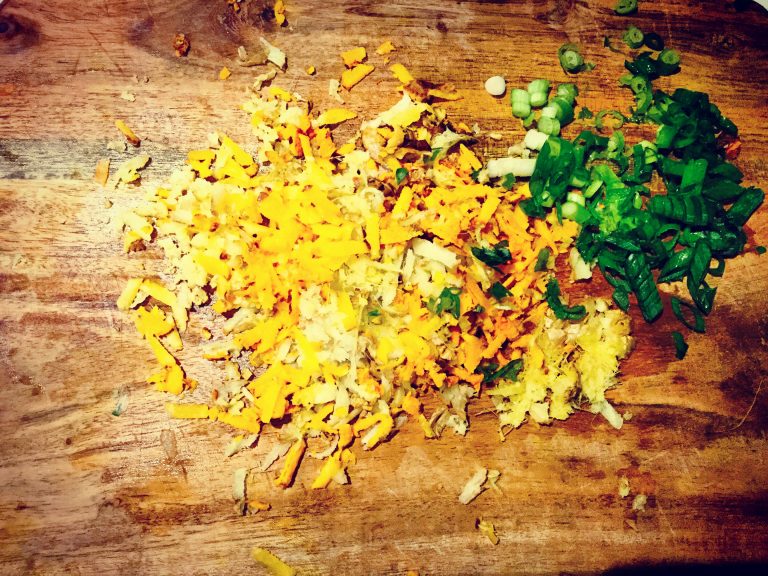
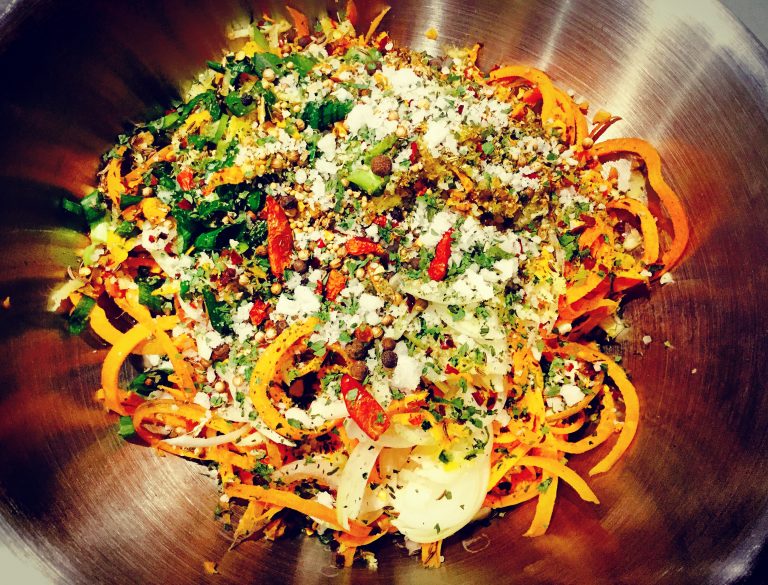
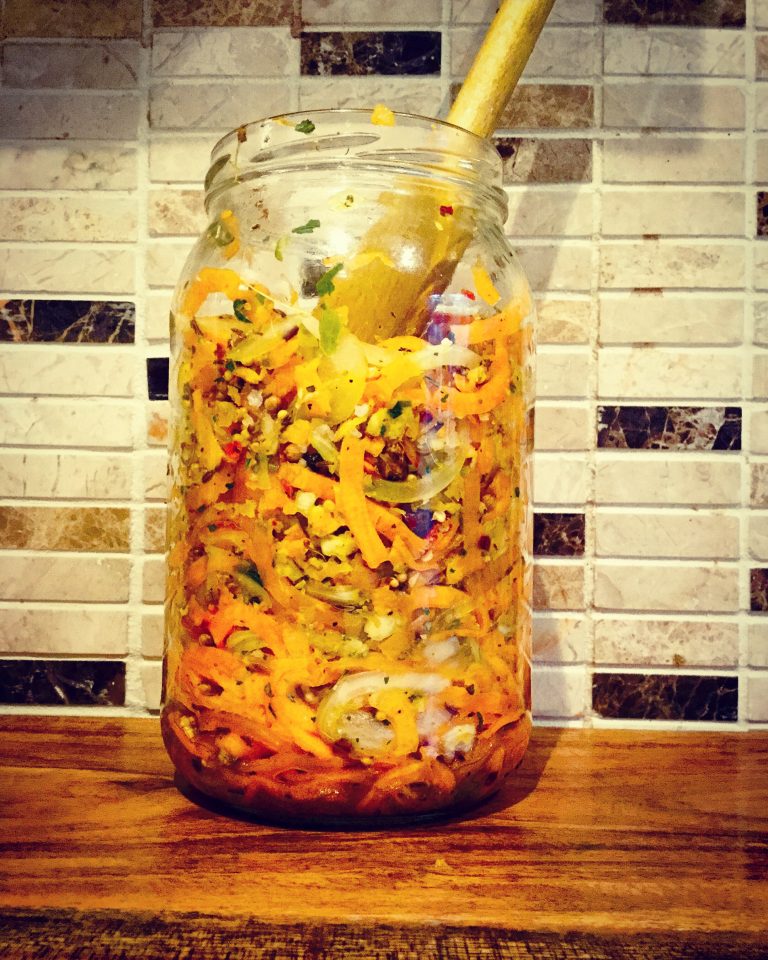
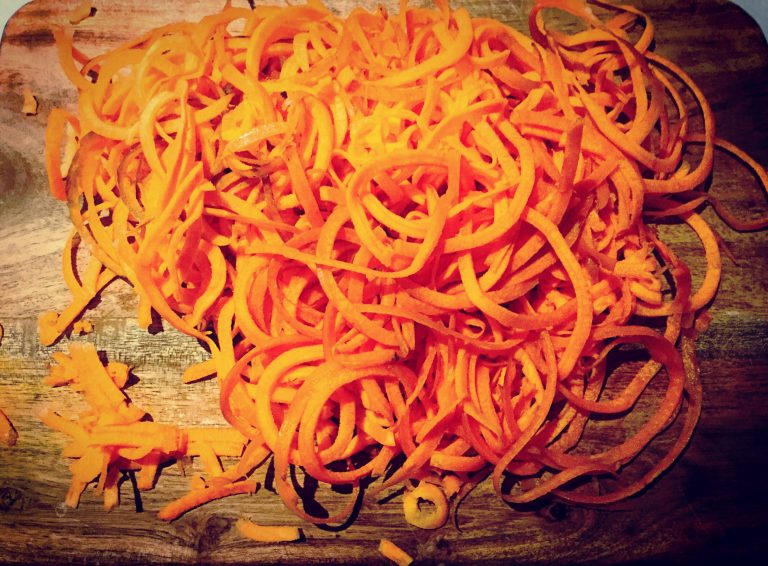
We spiralized the carrots into “noodles”, chopped the onion and garlic, grated the ginger and turmeric, mixed everything with the herbs and spices in a bowl, packed it into a large jar with a wooden spoon, and topped it up with water to cover. We left it for about 10–14 days out of the sun with the lid resting on top, not sealed. We mixed it every other day and pushed the carrots back under the liquid.

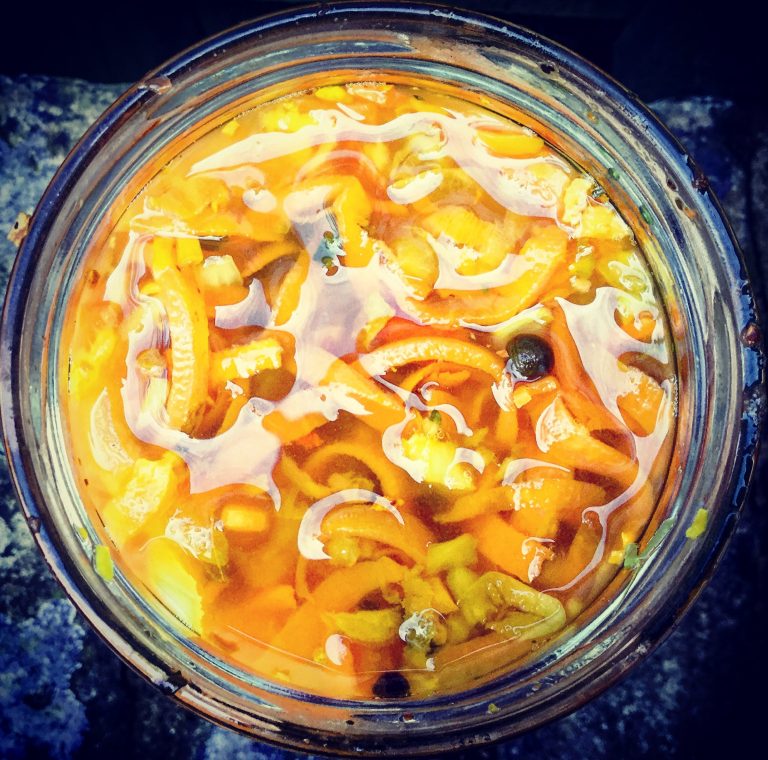
What we’d change today: we’d weigh the salt against the water (2–3%) instead of using spoons, and keep the carrots under a weight rather than opening and stirring the jar, which lets air in. You can see a thin white film on the brine in one of our photos – typical of kahm yeast, which is exactly what keeping everything submerged helps prevent.

Ingredients for fermented carrots: whole carrots, onion, spring onions, garlic, ginger, turmeric, sea salt, dried herbs and spices, and an empty glass jar
Our 2016 ingredients: carrots, aromatics, salt, herbs and pickling spices.
A pile of spiralized carrot noodles on a wooden board
Carrots spiralized into noodles.
Grated ginger and turmeric next to sliced spring onions on a chopping board
Grated ginger and turmeric with sliced spring onion.
Spiralized carrots mixed with onion, chili, herbs, spices and salt in a steel bowl
Everything mixed with the herbs, spices and salt.
Spiced spiralized carrots packed into a large glass jar with a wooden spoon
Packed into the jar and pressed down with a wooden spoon.
A tall jar of fermenting spiralized carrots with a green lid, outdoors on a stone wall
The finished jar.
Top view into a jar of fermenting carrots with a thin white film on the surface of the brine
A thin white film on the brine – typical of kahm yeast. Keeping the carrots submerged helps prevent it.

Frequently asked questions

How much salt do I need to ferment carrots?

Use a 2–3% brine: 10–15 g of non-iodized salt per 500 ml of water. Weigh it if you can, because spoon measures of salt vary widely.

How long do carrots take to ferment?

Usually 5–10 days at 65–75°F (18–24°C). Start tasting on day 4 and refrigerate when you like the flavor. Shredded carrots ferment faster than sticks.

Do I need to peel the carrots?

No. Scrub them well; peeling is a matter of taste. The bacteria that ferment them are on the vegetables and in the kitchen, and there are plenty either way.

Do I need a starter culture?

No. Carrots ferment on their own naturally occurring bacteria. A spoonful of brine from a previous healthy batch can speed things up.

Why is the brine cloudy?

Cloudy brine is normal – it's the bacteria and their byproducts. It's a sign fermentation is under way.

Is the white film on my carrots mold?

A flat, smooth white film is usually kahm yeast, a harmless yeast that can affect flavor; skim it off. Fuzzy, raised or colored spots are mold, and the batch should be thrown away.

How long do fermented carrots last?

In the fridge, kept under their brine and handled with clean utensils, they keep for months, slowly getting more sour and softer.

Are fermented carrots the same as pickled carrots?

Not quite. Vinegar pickles are soured with vinegar and usually heated, so they have no live bacteria. Fermented carrots are soured by lactic acid bacteria and, if not heated, still contain them.

Sources

  1. National Center for Home Food Preservation. General information on fermenting. Link
  2. National Center for Home Food Preservation. Causes and possible solutions for problems with fermented pickles. Link
  3. USDA FoodData Central. Carrots, raw (SR Legacy 170393). Link
Share: