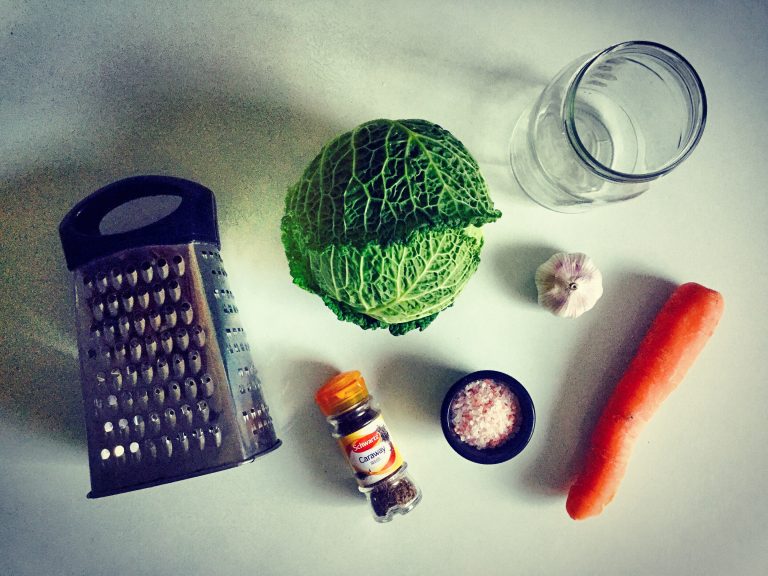
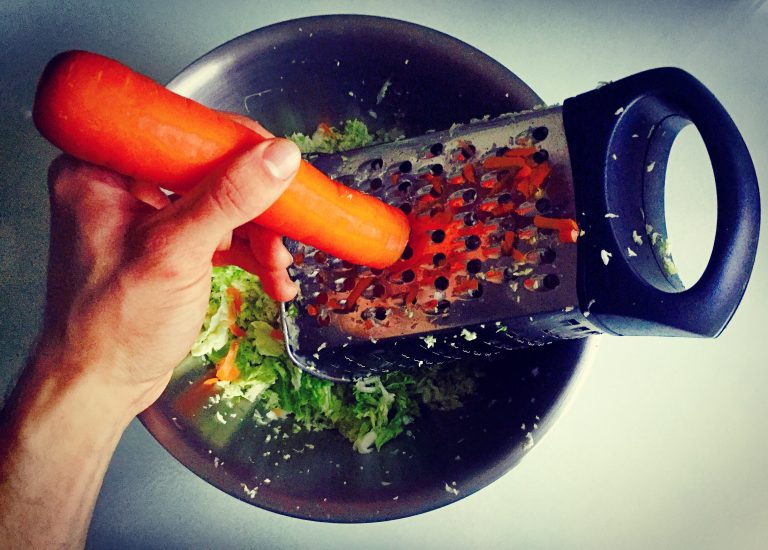
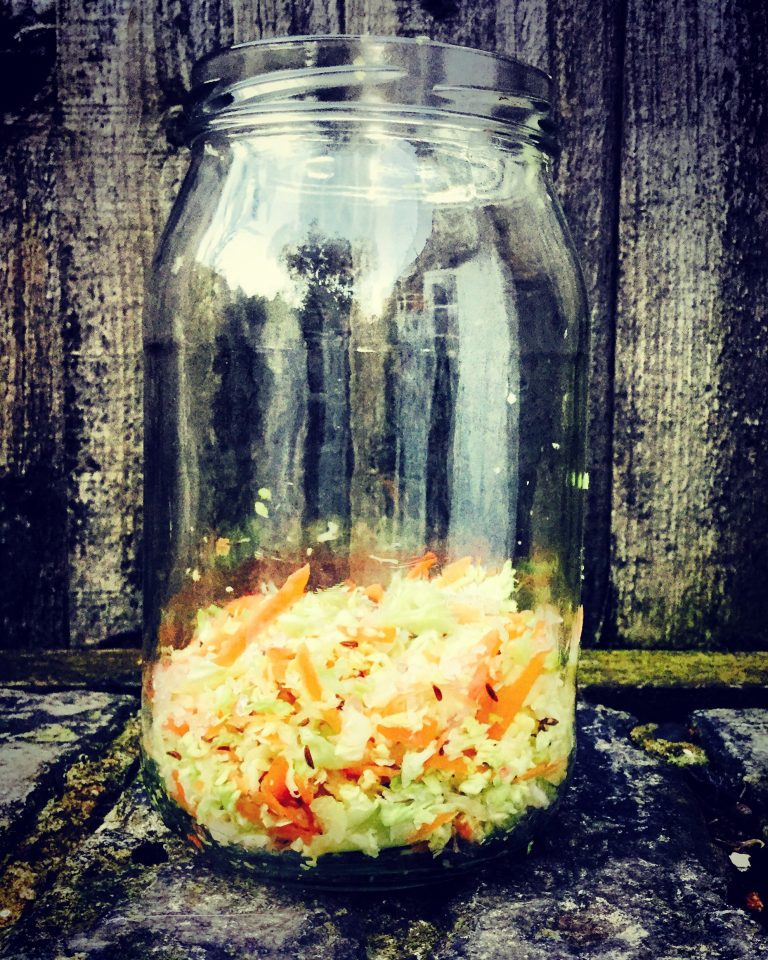
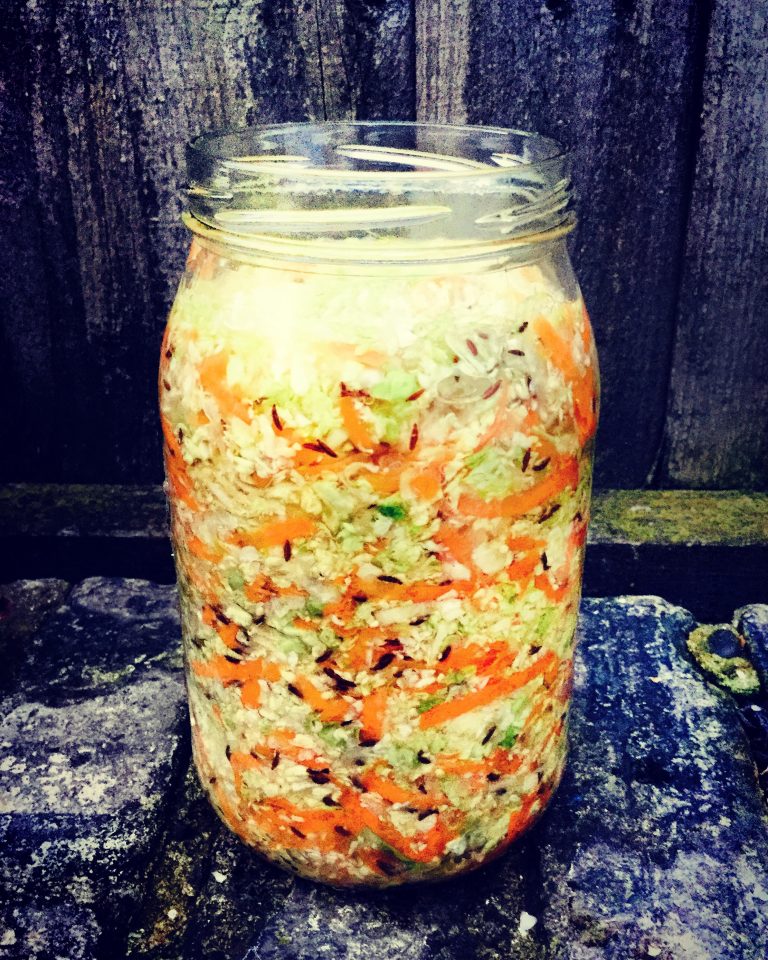
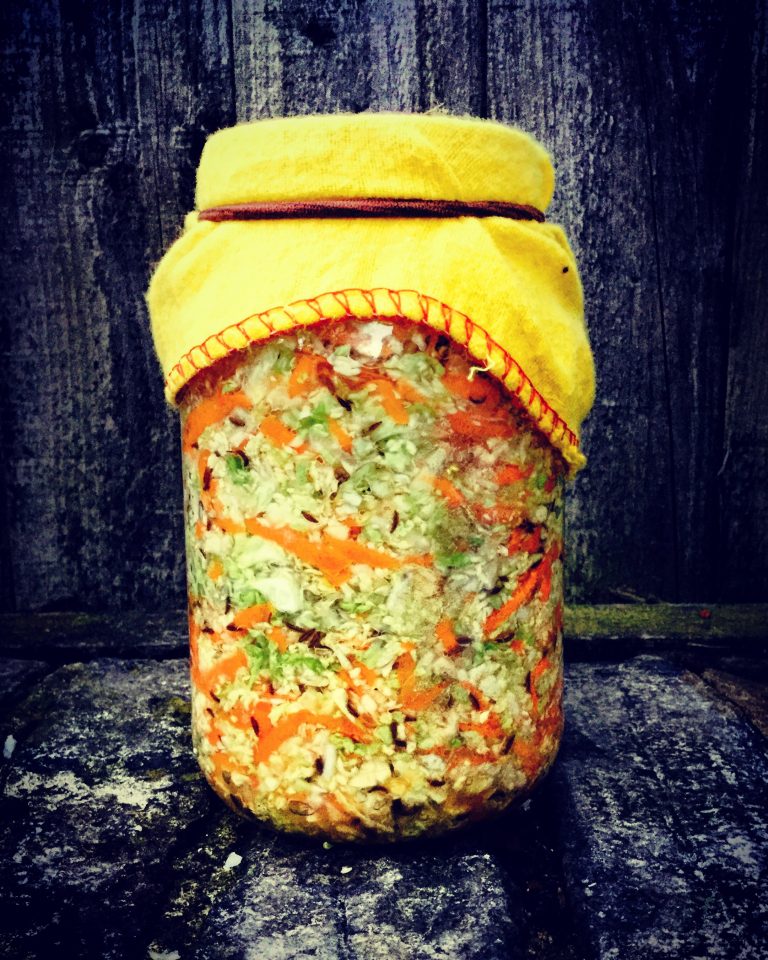
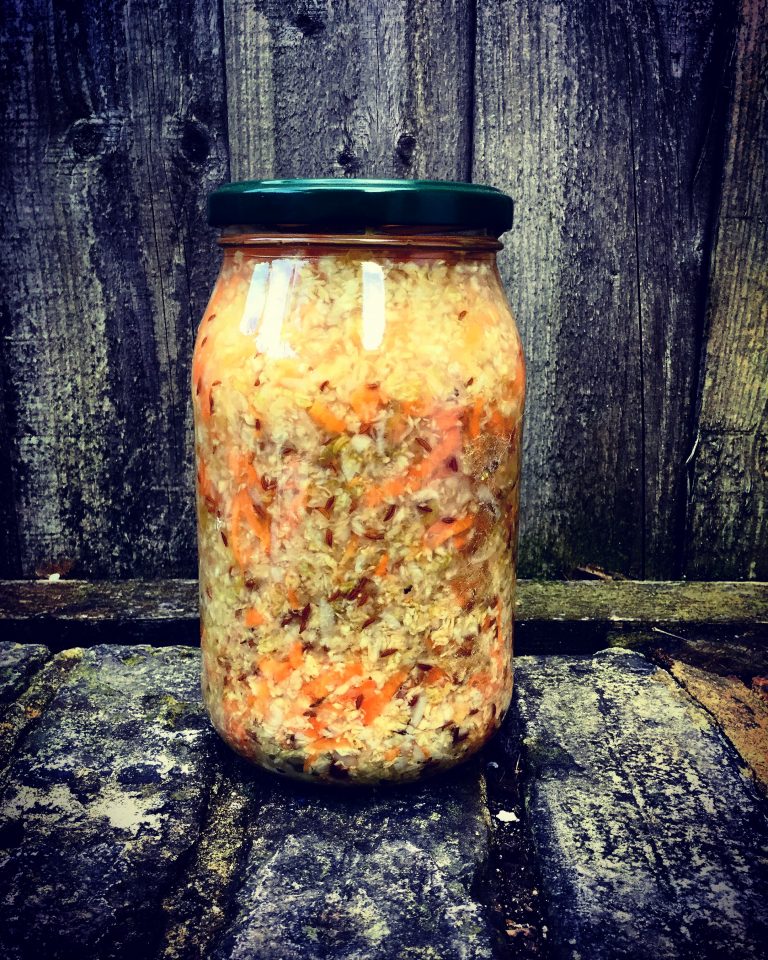
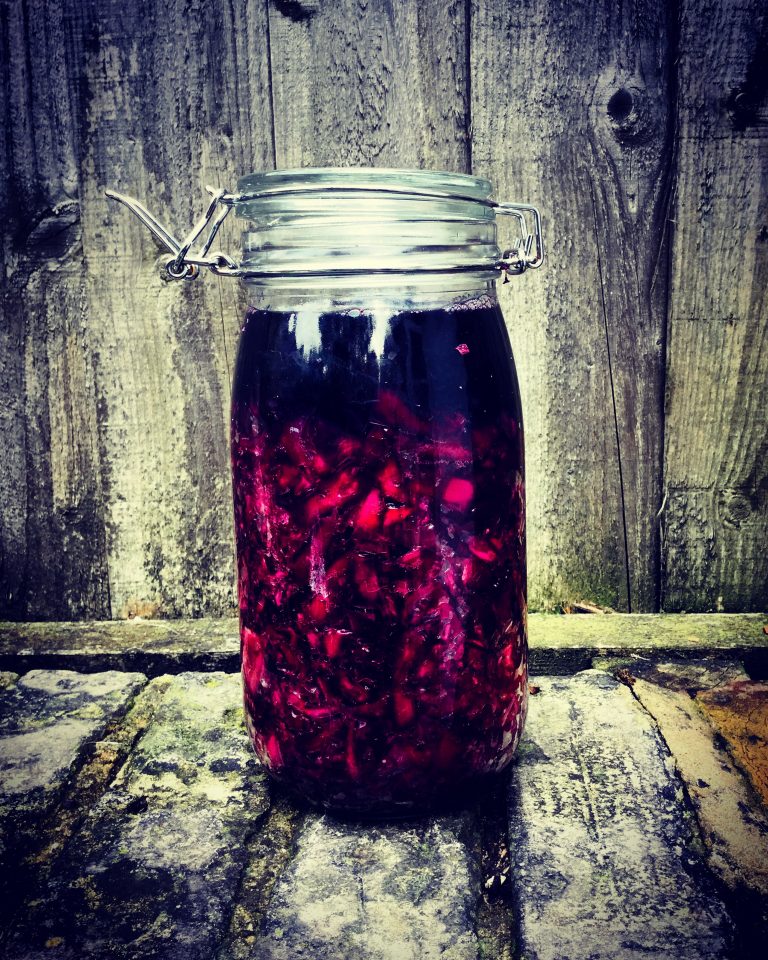
Sauerkraut is just shredded cabbage and salt. Massaged and packed tightly, the cabbage releases its own juice, and lactic acid bacteria that are already on the leaves turn it sour over a few weeks. The only things you really need to get right are the amount of salt, keeping the cabbage under its brine, and the temperature. The recipe card above follows the tested proportions from the US National Center for Home Food Preservation (NCHFP); below it is the caraway kraut we first made and photographed in 2016.
The Salt Ratio
NCHFP uses 3 tablespoons of canning or pickling salt per 5 lb (about 2.3 kg) of cabbage – roughly 2–2.5% of the cabbage’s weight (NCHFP). In grams, that’s about 20–25 g of salt per 1 kg of shredded cabbage. Weigh the cabbage after removing the outer leaves and core.
- Too little salt lets spoilage organisms and mold get a head start and gives soft kraut.
- Too much salt slows fermentation and makes the kraut harsh.
- Canning or pickling salt is the standard; iodized table salt is safe too, though its anti-caking agents can cloud the brine (NCHFP). Spoon measures vary between fine and flaky salts, so weigh it: our salt and brine calculator gives the grams for any weight of cabbage.
How Long to Ferment Sauerkraut
| Temperature | Time (NCHFP) |
|---|---|
| 70–75°F (21–24°C) | About 3–4 weeks |
| 60–65°F (16–18°C) | About 5–6 weeks |
| Below 60°F (16°C) | May not ferment |
| Above 75°F (24°C) | May become soft |
Many home fermenters start eating sauerkraut earlier, after one to two weeks, when it’s tangy but still crunchy. Fully fermented kraut, kept tightly covered in the refrigerator, keeps for several months (NCHFP) – see how long sauerkraut lasts. For a shelf-stable jar, NCHFP’s boiling-water times are in canning sauerkraut and fermented pickles.
Keeping It Under the Brine
Pack the cabbage down hard so its juice rises over it, and keep it there with a weight – a smaller jar, a glass weight, or a zip bag filled with brine. If there isn’t enough juice to cover it after a day, top it up with brine made from 1½ tablespoons of salt per quart (about 1 litre) of water (NCHFP). NCHFP also advises checking two or three times a week and removing any scum that forms when you use jars as weights.
Variations
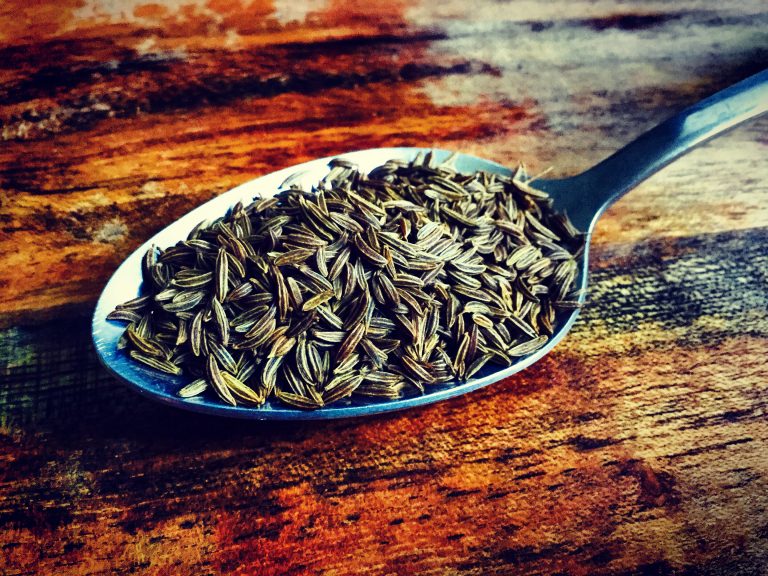
- Caraway (the classic): 1 tbsp caraway seeds per head – our 2016 version also had grated carrot and garlic.
- Red cabbage and beetroot: a deep purple kraut – we made one in 2016 too.
- Carrot and ginger: grate in a carrot and a thumb of ginger.
- Turmeric: a little fresh turmeric and black pepper.
- Apple and juniper: a grated apple and a few juniper berries.
- Different cabbages: firm green or Savoy cabbage works well; red cabbage gives a pink-purple kraut.
For Korean-style cabbage, see our kimchi recipe and sauerkraut vs kimchi.
Troubleshooting
- White film or scum: usually kahm yeast; skim it off and keep the cabbage submerged. Fuzzy or colored mold, a rotten smell or slimy kraut means discard (NCHFP).
- Soft kraut: too warm (above 75°F), too little salt, or air pockets.
- Not enough brine: press harder, wait a day, then top up with brine.
- Too salty: give it more time, or rinse before eating.
Sauerkraut Nutrition
Per 100 g, canned sauerkraut has about 19 kcal, 2.9 g of fiber and 661 mg of sodium (USDA FoodData Central); homemade kraut varies with the salt you use. Raw, unpasteurized sauerkraut also contains live lactic acid bacteria; canned or heated kraut doesn’t.
Prefer to buy it? See the best sauerkraut brands and the best time to eat sauerkraut.